Search Result

Popular Posts

Showing posts with label Lotus. Show all posts

Lotus Elite, 1973

Friday, July 15, 2011

Lotus Elite, 1973

Lotus Elite, 1973, antique car, vintage car, old car

Lotus' first saloon car was front engined with rear wheel drive. Like all production Lotuses since the Elan, the Elite II used fiberglass for the hatchback bodyshell, mounted on a steel backbone chassis evolved from the Elan and Europa. It had 4-wheel independent suspension using coil springs. Power steering and air conditioning were optional from 1974. The Elite II was the basis for the Eclat, and the later Excel four-seaters.

The Elite II was Lotus' first car to use the "907" aluminium-block 4-valve, DOHC, four cylinder, 2.0 L engine. (The 907 engine had previously been used in Jensen-Healeys.) The 907 engine ultimately became the foundation for the Lotus Esprit powerplants, both naturally-aspirated and turbocharged. Elite IIs were available with a 5-speed gearbox standard; from January 1976 an automatic transmission was optional.

The Elite and Elite II (and the related Eclat) are notable in that the stock curb weight is not much over 2000 lb (907 kg). Once the motors reach their power band, both acceleration and handling are impressive.

Lotus Europe

Wednesday, May 25, 2011

Lotus Europe 1965

1965, Lotus
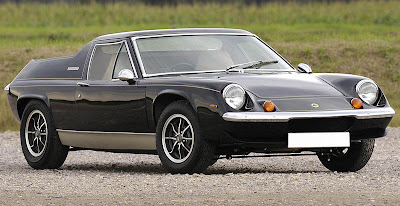
Lotus Europe, a two door mid-engined GT coupé built by Lotus Cars from 1966 to 1975.

The original Lotus Europa used Lotus founder Colin Chapman's minimalist steel backbone chassis that was first used in the Lotus Elan, while also relying on its fibreglass moulded body for structural strength. The Europa was the first mass-produced mid-engine road car and was based on a prototype built to compete for Henry Ford II's contract to build a Le Mans race car in the early 1960s.

The Lotus Europa was designed and built to be an embodiment of Chapman's oft-stated philosophy of automotive design: "Simplify, then add lightness."

The 4-wheel independent suspension was typical of Chapman's thinking; the rear suspension consisted of two relatively large trailing arms, one lower locating link per side, and the axles were used as upper locating links; very similar to Formula racing car designs of that era. Aside from the doors, bonnet (hood), and trunk (boot), the body was cast as a single unit of fibreglass.

The car's handling prompted automotive writers to describe the Europa as the nearest thing to a Formula car for the road.

1965, LotusSeries 1

The Series 1 or S1 Europa (also known as Lotus Type 46) was announced for sale to European markets on December 20, 1966. The first cars were delivered in France in February 1967, sold as Lotus Europe. The S1 was fitted with a modified Renault 16 1470 cc engine and a 4-speed gearbox. The engine was a special 82 hp (61 kW) version (as opposed to the 52 hp (39 kW) generated in standard form). Lotus turned the engine and gearbox through 180° to accommodate the Europa's longitudinal mid-engined layout, inverting the gearbox's crown wheel and its pinion gear to avoid having four reverse gears. The S1 weighed 686 kg (1512 lb), had a top speed of 110 mph (180 km/h), and did 0-60 mph in 10 seconds. Of particular note, nearly 0.9 g (8 m/s²) lateral acceleration was achieved on road tires of that era.

Including the S1A and S1B (which incorporated some of the later S2 changes) variations, 644 Europa S1s were manufactured.
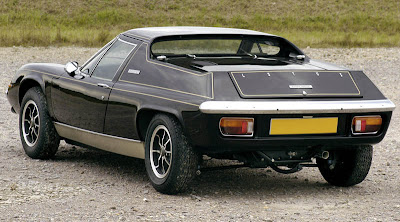
1965, Lotus Type 47

During 1966, whilst the Factory was sorting out the first production Type 46 (S1), Team Lotus raced the Type 47, a Europa modified for the track, with a 165 hp (123 kW) 1594 cc Lotus/Ford/Cosworth twin cam engine, which used a Cosworth-modified Kent block, and a Hewland FT 200 5-speed gearbox. The Type 47 is fondly remembered for taking both first and second places (driven by John Miles and Jackie Oliver, respectively) in its very first race held at the storied Brands Hatch race course on Boxing Day. It's believed that 55 Type 47s were built by Lotus between 1966-70. Two other sports racer prototypes based on the Europa called, Type 62, were built in 1969. A twin-cam powered Europa would not be available to the roadgoing public until the Type 74, in 1971. Replica 47s are bespoke-manufactured by Banks Europa Engineering, in several variations. A one-off 47, fitted with a Rover V8 engine, was built by GKN in 1968 and registered, GKN 47 D.

Series 2
The Europa S2, or Type 54, was introduced in April 1968. It used the same Renault engine as the Type 46, but offered a number of refinements, including electric windows, fully adjustable seats, a new interior, and a polished wooden facia for the dashboard. Per request of the automotive insurance industry, Lotus switched to bolt fasteners (instead of resin bonding) to attach body to frame. A red Type 54 Europa S2 was driven by co-star Linda Thorson in several 1968 episodes of The Avengers (TV series). A small number of Type 54s were modified to be "federalized", that is, made suitable for export to the United States.

In 1969, the Type 65 aka S2 Federal was born, with additional changes to the body, chassis, and the powerplant to better comply with U.S. D.O.T. standards. Among the newer bits, the Renault engine was expanded to 1565 cc capacity over the previous 1470 cc. Road&Track Magazine tested the Federal S2 and recorded 0-60 mph in 9.6 seconds with a top speed of 116 mph (187 km/h). 3,615 S2s were produced.
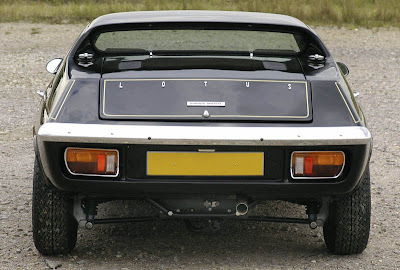
1965, LotusTwin Cam and Special

In 1971, the Type 74 Europa Twin Cam was made available to the public, with a 115 hp (78 kW) 1558 cc "big valve" Lotus-Ford Twin Cam engine (105 hp US Federal emissions control version until the end of production), a new Renault 4-speed gearbox (Type 352) and a re-designed bodyshell to improve rearward visibility. Mike Kimberley, who rose to become chief executive of Group Lotus, then a new engineer at Lotus, was appointed Chief Engineer of the Europa TC project. 1,580 cars were shipped as Europa Twin Cam before Lotus switched to a 126 hp (94 kW) aspirated by Dellorto/Weber carburettors version of the same engine; in addition to offering a new Renault 5-speed (Type 365) gearbox option; and renamed the car Europa Special. It weighed 740 kg (1631 lb), had a top speed of 123 mph (198 km/h), did 0-60 mph in 7.0 seconds, and ran the 1/4mile in 14.9 sec. A total of 3,130 Specials were manufactured. To honour Team Lotus's 1972 and 1973 F1 World Championships, a few black with gold pin stripe - plus numbered badge - Europa Specials were offered as the first ever John Player Special commemorative motor vehicles.

Lotus Elan

Thursday, May 19, 2011

Lotus Elan 1962

1962, Lotus
The original Elan was introduced in 1962 as a roadster, although an optional hardtop was offered in 1963 and a coupé version in 1965. It was the first Lotus road car to use the now famous steel backbone chassis with a fibreglass body. At 1500 lb (680 kg), the Elan embodied the Colin Chapman minimum weight design philosophy. Initial versions of the Elan were also available as a kit to be assembled by the customer. The Elan was technologically advanced with a twin-cam 1558 cc engine, 4-wheel disc brakes, and 4-wheel independent suspension.

1962, Lotus
The Lotus-Ford Twin Cam engine was based on Ford's Kent, with a Lotus-inspired Cosworth alloy twin-cam head. This Lotus-Ford 4-cylinder engine would go on to be used in a number of Lotus production and racing models. An Elan +2 was introduced in 1967 with a longer wheelbase and two more rear seats. The Elan ceased production in 1973 and the Elan +2 in 1975. An estimated total of 17,000 original Elans and Elan +2's were built. Because of its successful design and technological sophistication, the Elan went on to become Lotus' first commercial success, reviving a company stretched thin by the more exotic and less commercially successful Elite, and enabling funding of the Lotus success in racing over the next ten years.

1962, Lotus
This generation of the two seater Elan was famously driven by the character Emma Peel on the British television series The Avengers. In 2004, Sports Car International named the Elan number six on the list of Top Sports Cars of the 1960s. The original version of the car was designed by Ron Hickman, who also designed the first Lotus Europa as part of Lotus' GT40 project bid and made his fortune having designed the Black & Decker WorkMate.

Lotus Elise, 1999

Sunday, February 13, 2011

Lotus Elise, 1999


The Lotus Elise is a roadster conceived in early 1994 and released in September 1996 by the English manufacturer Lotus Cars. The car has a hand-finished fiberglass body shell atop its aluminium extrusion and bonded frame that provides a rigid platform for the suspension, while keeping weight and production costs to a minimum. The roadster is capable of speeds up to 240 km/h (150 mph).

The original Elise, called the Series 1 was augmented by a faster edition called the 111S, named after the Lotus type-number of the Elise — M111. The 111S was introduced in early 1999 and contained a VVC Rover K-Series engine with a modified head and VVT type technology producing a declared 143 bhp (107 kW) rather than the standard Rover 1.8 L K-series 118 bhp (88 kW) unit, along with a closer ratio gearbox and lower ratio final drive. It also had more padding in the seats. The 111S also received some cosmetic changes including: headlamp covers, rear spoiler, cross drilled brake discs, alloy window winders and a new 6 spoke road wheel design.
 

Lotus Elise 160, 1996

Lotus Elise 160, 1996


The design philosophy of Lotus is "Performance through light weight", a philosophy first adopted by the founder of Lotus, Colin Chapman. The motto drives Lotus to obtain very high performance with lightweight cars in spite of their relatively modest power outputs, with a strong emphasis on driving purity and dynamics.

The result is a sports car that in production form in 1996 weighed in at just 720 kg (1,587 lb). Compare this to a Porsche Boxster which is also considered to be an extremely lightweight sports car but weighs nearly twice as much: 1,250 kg (2,756 lb).

The Lotus Elise's acceleration (0-60mph in 5.8 seconds), braking, cornering, and fuel consumption (all of which are improved by reductions in a car's weight) were astonishing for an engine put out a relatively modest 120 bhp (89 kW), compared to the 201 bhp (149 kW) produced by the 1997 Porsche Boxster.

Though high-tech, it represented affordable cost of ownership for sports car lovers on a budget who still wanted performance and looks.

Besides the "standard" higher-performance variants listed below, Lotus also released some limited edition models such as Sport 135 (1998/9) with approx 145 bhp (108 kW), Sport 160 (2000) with 150-160 bhp (112-119 kW) and Sport 190 (190 bhp / 142 kW). These were more competent on track with sports suspension, wheels and tyres, seats according to model. There were other special editions which were basically cosmetic treatments such as the 50th Anniversary Edition (green/gold) celebrating 50 years of Lotus cars, the Type 49 ("Gold Leaf" red and white two-tone), and Type 72 ("JPS" black/gold) to recall their successful Grand Prix car type numbers.

Lotus Esprit Turbo, 1980

Sunday, January 23, 2011

Lotus Esprit Turbo, 1980


By the close of 1980, Lotus were effectively building three different models of Esprit, with distinct chassis designs and body moulds - the Domestic (i.e. UK) S2.2, the Export S2.2, and the dry-sump Turbo Esprit. Introduced in April 1981, the Turbo Esprit and S3 (Series 3) Esprits marked a necessary consolidation: both new models had a common chassis, inheriting much of the configuration of the Essex cars, whilst body production was based on a single common set of moulds.

The S3 continued to use the 2.2 L type 910 engine of the S2.2, whilst the Turbo Esprit reverted to a less complex wet-sump lubrication system, retaining the power and torque outputs of its dry-sump predecessor. The interior for both cars was revised and featured new trim; combined with changes to the body moulds this resulted in more headroom and an enlarged footwell. Externally, the Turbo Esprit retained the full aerodynamic body kit of the Essex cars, and featured prominent 'turbo esprit' decals on the nose and sides; the S3 gained the more substantial bumpers, yet retained the simpler sill line and glazed rear hatch of the S2.2 body style. Both models were supplied with 15" BBS alloy wheels.

In April 1986, the final incarnations of the Giugiaro-styled Esprit were announced, with raised engine compression giving rise to their 'HC' moniker. This increased the output of the naturally aspirated engine to 172 horsepower (128 kW) and 160 lb·ft (220 N·m) for the Esprit HC, and to 215 horsepower (160 kW) and 220 lb·ft (300 N·m) for the Turbo Esprit HC, with the increased torque available at a lower rpm. For markets with stringent emissions requirements, Lotus introduced the HCi variant, teaming the higher compression engine with Bosch KE-Jetronic fuel injection - the first fuel-injected Esprits.

Lotus Esprit Concept, 1972

Lotus Esprit Concept, 1972


The Lotus Esprit was a sports car built by Lotus in the United Kingdom from 1976 to 2004. The silver Italdesign concept that eventually became the Esprit was unveiled at the Turin Motor Show in 1972, and was a development of a stretched Lotus Europa chassis. It was among the first of designer Giorgetto Giugiaro's polygonal "folded paper" designs. Originally, the name Kiwi was proposed, but in keeping with the 'E...' naming format of Lotus tradition, the name became Esprit.

Lotus Europa, 1965

Monday, November 8, 2010

Lotus Europa, 1965
<Click thumbnails to enlarge>


The Lotus Europa or Lotus Europe, a two door mid-engined GT coupé built by Lotus Cars from 1966 to 1975.

The original Lotus Europa used Lotus founder Colin Chapman's minimalist steel backbone chassis that was first used in the Lotus Elan, while also relying on its fibreglass moulded body for structural strength. The Europa was the first mass-produced mid-engine road car and was based on a prototype built to compete for Henry Ford II's contract to build a Le Mans race car in the early 1960s.

The Lotus Europa was designed and built to be an embodiment of Chapman's oft-stated philosophy of automotive design: "Simplify, then add lightness."

The 4-wheel independent suspension was typical of Chapman's thinking; the rear suspension consisted of two relatively large trailing arms, one lower locating link per side, and the axles were used as upper locating links; very similar to Formula racing car designs of that era. Aside from the doors, bonnet (hood), and trunk (boot), the body was cast as a single unit of fibreglass.

The car's handling prompted automotive writers to describe the Europa as the nearest thing to a Formula car for the road.

Series 1
The Series 1 or S1 Europa (also known as Lotus Type 46) was announced for sale to European markets on December 20, 1966. The first cars were delivered in France in February 1967, sold as Lotus Europe. The S1 was fitted with a modified Renault 16 1470 cc engine and a 4-speed gearbox. The engine was a special 82 hp (61 kW) version (as opposed to the 52 hp (39 kW) generated in standard form). Lotus turned the engine and gearbox through 180° to accommodate the Europa's longitudinal mid-engined layout, inverting the gearbox's crown wheel and its pinion gear to avoid having four reverse gears. The S1 weighed 686 kg (1512 lb), had a top speed of 110 mph (180 km/h), and did 0-60 mph in 10 seconds. Of particular note, nearly 0.9 g (8 m/s²) lateral acceleration was achieved on road tires of that era.

Type 47
During 1966, whilst the Factory was sorting out the first production Type 46 (S1), Team Lotus raced the Type 47, a Europa modified for the track, with a 165 hp (123 kW) 1594 cc Lotus/Ford/Cosworth twin cam engine, which used a Cosworth-modified Kent block, and a Hewland FT 200 5-speed gearbox. The Type 47 is fondly remembered for taking both first and second places (driven by John Miles and Jackie Oliver, respectively) in its very first race held at the storied Brands Hatch race course on Boxing Day. It's believed that 55 Type 47s were built by Lotus between 1966-70. Two other sports racer prototypes based on the Europa called, Type 62, were built in 1969. A twin-cam powered Europa would not be available to the roadgoing public until the Type 74, in 1971. Replica 47s are bespoke-manufactured by Banks Europa Engineering, in several variations. A one-off 47, fitted with a Rover V8 engine, was built by GKN in 1968 and registered, GKN 47 D.

Series 2
The Europa S2, or Type 54, was introduced in April 1968. It used the same Renault engine as the Type 46, but offered a number of refinements, including electric windows, fully adjustable seats, a new interior, and a polished wooden facia for the dashboard. Per request of the automotive insurance industry, Lotus switched to bolt fasteners (instead of resin bonding) to attach body to frame. A red Type 54 Europa S2 was driven by co-star Linda Thorson in several 1968 episodes of The Avengers (TV series). A small number of Type 54s were modified to be "federalized", that is, made suitable for export to the United States.

In 1969, the Type 65 aka S2 Federal was born, with additional changes to the body, chassis, and the powerplant to better comply with U.S. D.O.T. standards. Among the newer bits, the Renault engine was expanded to 1565 cc capacity over the previous 1470 cc. Road&Track Magazine tested the Federal S2 and recorded 0-60 mph in 9.6 seconds with a top speed of 116 mph (187 km/h). 3,615 S2s were produced.

Twin Cam and Special
In 1971, the Type 74 Europa Twin Cam was made available to the public, with a 115 hp (78 kW) 1558 cc "big valve" Lotus-Ford Twin Cam engine (105 hp US Federal emissions control version until the end of production), a new Renault 4-speed gearbox (Type 352) and a re-designed bodyshell to improve rearward visibility. Mike Kimberley, who rose to become chief executive of Group Lotus, then a new engineer at Lotus, was appointed Chief Engineer of the Europa TC project. 1,580 cars were shipped as Europa Twin Cam before Lotus switched to a 126 hp (94 kW) aspirated by Dellorto/Weber carburettors version of the same engine; in addition to offering a new Renault 5-speed (Type 365) gearbox option; and renamed the car Europa Special. It weighed 740 kg (1631 lb), had a top speed of 123 mph (198 km/h), did 0-60 mph in 7.0 seconds, and ran the 1/4mile in 14.9 sec. A total of 3,130 Specials were manufactured. To honour Team Lotus's 1972 and 1973 F1 World Championships, a few black with gold pin stripe - plus numbered badge - Europa Specials were offered as the first ever John Player Special commemorative motor vehicles.

Lotus Elan, 1962

Lotus Elan, 1962
 <Click thumnails to enlarge>


The original Elan was introduced in 1962 as a roadster, though an optional hardtop was offered in 1963 and a coupé version in 1965. It was the first Lotus road car to use the now famous steel backbone chassis with a fibreglass body. At 1500 lb (680 kg), the Elan embodied the Colin Chapman minimum weight design philosophy. Initial versions of the Elan were also  as a kit to be assembled by the customer. The Elan was technologically advanced with a twin-cam 1558 cc engine, 4-wheel disc brakes, and 4-wheel independent suspension. The Lotus-Ford Twin Cam engine was based on Ford's Kent, with a Lotus-inspired Cosworth alloy twin-cam head. This Lotus-Ford 4-cylinder engine would go on to be used in a number of Lotus production and racing models. An Elan +2 was introduced in 1967 with a longer wheelbase and two more rear seats. The Elan ceased production in 1973 and the Elan +2 in 1975. An estimated total of 17,000 original Elans and Elan +2's were built. Because of its successful design and technological sophistication, the Elan went on to become Lotus' first commercial success, reviving a company stretched thin by the more exotic and less commercially successful Elite, and enabling funding of the Lotus success in racing over the next ten years.

The generation of the 2 seater Elan was famously driven by the character Emma Peel on the British television series The Avengers. In 2004, Sports Car International named the Elan number six on the list of Top Sports Cars of the 1960s. The original version of the car was designed by Ron Hickman, who also designed the first Lotus Europa as part of Lotus' GT40 project bid and made his fortune having designed the Black & Decker WorkMate.

Lotus Esprit Turbo, 1980

Tuesday, August 10, 2010

Lotus Esprit Turbo, 1980


By the close of 1980, Lotus were effectively building three different models of Esprit, with distinct chassis designs and body moulds - the Domestic (i.e. UK) S2.2, the Export S2.2, and the dry-sump Turbo Esprit. Introduced in April 1981, the Turbo Esprit and S3 (Series 3) Esprits marked a necessary consolidation: both new models had a common chassis, inheriting much of the configuration of the Essex cars, whilst body production was based on a single common set of moulds.

The S3 continued to use the 2.2 L type 910 engine of the S2.2, whilst the Turbo Esprit reverted to a less complex wet-sump lubrication system, retaining the power and torque outputs of its dry-sump predecessor. The interior for both cars was revised and featured new trim; combined with changes to the body moulds this resulted in more headroom and an enlarged footwell. Externally, the Turbo Esprit retained the full aerodynamic body kit of the Essex cars, and featured prominent 'turbo esprit' decals on the nose and sides; the S3 gained the more substantial bumpers, yet retained the simpler sill line and glazed rear hatch of the S2.2 body style. Both models were supplied with 15" BBS alloy wheels.

In April 1986, the final incarnations of the Giugiaro-styled Esprit were announced, with raised engine compression giving rise to their 'HC' moniker. This increased the output of the naturally aspirated engine to 172 horsepower (128 kW) and 160 lb·ft (220 N·m) for the Esprit HC, and to 215 horsepower (160 kW) and 220 lb·ft (300 N·m) for the Turbo Esprit HC, with the increased torque available at a lower rpm. For markets with stringent emissions requirements, Lotus introduced the HCi variant, teaming the higher compression engine with Bosch KE-Jetronic fuel injection - the first fuel-injected Esprits.

Lotus Elan

Tuesday, April 27, 2010

Lotus Elan, 1962


The original Elan was introduced in 1962 as a roadster, although an optional hardtop was offered in 1963 and a coupé version in 1965. It was the first Lotus road car to use the now famous steel backbone chassis with a fibreglass body. At 1500 lb (680 kg), the Elan embodied the Colin Chapman minimum weight design philosophy. Initial versions of the Elan were also available as a kit to be assembled by the customer.

The Elan was technologically advanced with a twin-cam 1558 cc engine, 4-wheel disc brakes, and 4-wheel independent suspension. The Lotus-Ford Twin Cam engine was based on Ford's Kent, with a Lotus-inspired Cosworth alloy twin-cam head. This Lotus-Ford 4-cylinder engine would go on to be used in a number of Lotus production and racing models. An Elan +2 was introduced in 1967 with a longer wheelbase and two more rear seats. The Elan ceased production in 1973 and the Elan +2 in 1975. An estimated total of 17,000 original Elans and Elan +2's were built. Because of its successful design and technological sophistication, the Elan went on to become Lotus' first commercial success, reviving a company stretched thin by the more exotic and less commercially successful Elite, and enabling funding of the Lotus success in racing over the next ten years.

The generation of the two seater Elan was famously driven by the character Emma Peel on the British television series The Avengers. In 2004, Sports Car International named the Elan number six on the list of Top Sports Cars of the 1960s. The original version of the car was designed by Ron Hickman, who also designed the first Lotus Europa as part of Lotus' GT40 project bid and made his fortune having designed the Black & Decker WorkMate.

Lotus Esprit Concept

Friday, April 9, 2010

Lotus Esprit Concept, 1972

Lotus Esprit Concept, 1972

The Lotus Esprit was a sports car built by Lotus in the United Kingdom from 1976 to 2004. The silver Italdesign concept that eventually became the Esprit was unveiled at the Turin Motor Show in 1972, and was a development of a stretched Lotus Europa chassis. It was among the first of designer Giorgetto Giugiaro's polygonal "folded paper" designs. Originally, the name Kiwi was proposed, but in keeping with the 'E...' naming format of Lotus tradition, the name became Esprit.